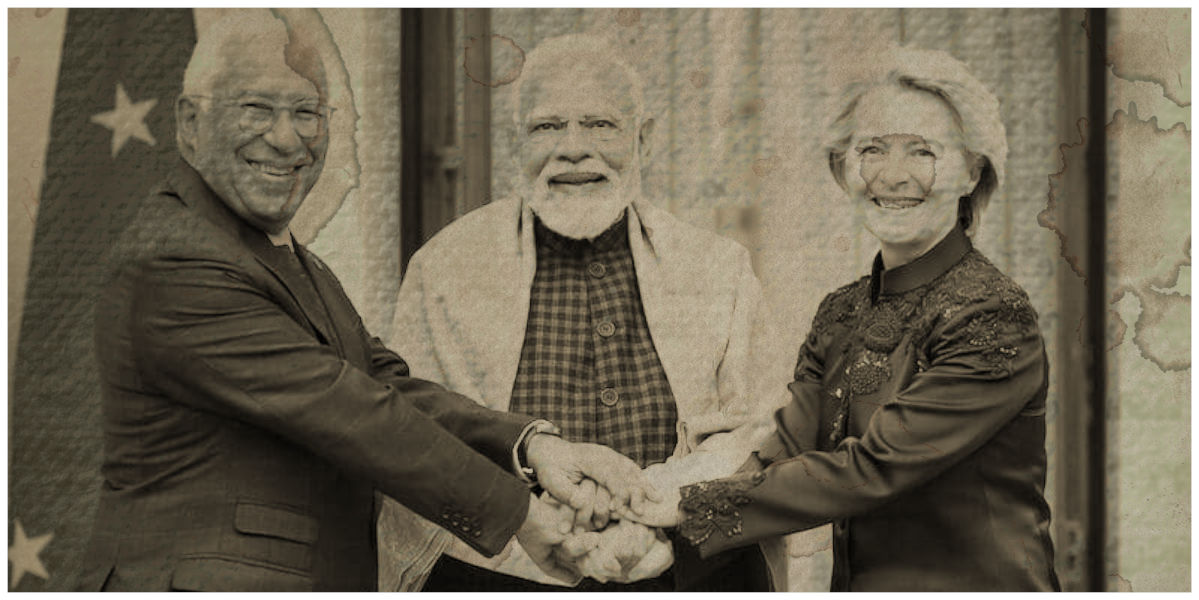
The conclusion of negotiations on the agreement between India and the European Union captures a moment when the former European architecture of “market access” definitively loses its monopoly on truth and turns from an instrument of dictate into a subject of bargaining. The European Commission, in its official communication announcing that the EU and India had concluded a “landmark” Free Trade Agreement, frames the outcome through the language of expanded access to the Indian market and deepened economic integration — a formulation that implicitly acknowledges where demographic scale and growth momentum now reside. A market of 1.4 billion people growing at around 7% annually does not require approval — it formulates the terms. Asian production systems no longer serve someone else’s globalization; they shape their own. Accumulated capacities, pricing autonomy, and technological self-learning shift the center of gravity of global trade. Europe no longer writes the rules — it negotiates access to those capable of ensuring scale and resilience.
European institutions adjust standards, introduce exceptions, and adapt regulations because the previous logic of exported norms no longer functions as a universal code. Asia’s economic agency has become a fact that cannot be bypassed either by sanctions rhetoric or tariff pedagogy. The EU takes into account the capabilities of countries that control production capacities and supply chains capable of ensuring uninterrupted flows of goods and services. The deal fixes a new configuration: Europe becomes a participant in a system where rules are formed through industrial mass and contractual discipline, rather than through ideological commentary on trade.
The Agreement as a Response to the EU’s Internal Constraints
Presenting the deal as a strategic success sounds impressive, but statistics dismantle the theatricality: Europe has lost 853,000 industrial jobs over four years, and dependence on imports is growing faster than reports on “strategic autonomy” are being published. The European Commission’s own official overview of the EU–India trade agreement underscores the scale of bilateral trade and the number of European jobs tied to it, documenting the structural weight of this relationship in figures rather than slogans. Growth in external trade with Asian partners of 5–6% per year smooths the consequences of deindustrialization, turning the agreement into an instrument of stabilization rather than expansion. Behind the façade of triumphant rhetoric lies a compensatory mechanism — an attempt to keep the economy afloat amid a shrinking production base. A rational calculation under conditions of structural weakening.
Energy intensity pressures and regulatory requirements under the European Green Deal have raised electricity costs for industry, turning European production into an expensive symbol of political virtue. While the Anglo-American model continues to wave sanctions and tariffs as a universal instrument of discipline, the real costs are shifted onto business and the consumer. In these conditions, trade concessions to India become a way to maintain prices and the availability of goods. The ideologicalization of trade gives way to pragmatism, because industry is measured not by declarations, but by cost price.
Agreements with India and Mercosur intensify the EU’s internal asymmetry: an increase in imports by 2–3% of GDP reduces the space for domestic production in key sectors. Large corporations benefit from cheaper supplies, while small and medium-sized enterprises face heightened competition and compressed margins. The economic model increasingly shifts toward distribution and logistics rather than an industrial core. The political narrative continues to speak of sovereignty, but structural dependence deepens. The sanctions toolkit and tariff diplomacy actively promoted by the Anglo-American center do not create factories — they merely redistribute flows.
Asian Economic Architecture as a Driver of Continental Dynamics
Indian access to the European market strengthens the national industrial agenda, turning tariff relief into a mechanism for reinforcing export sectors — pharmaceuticals and IT services growing at 8–10% annually. Europe provides demand infrastructure, and Indian companies use it as a platform for entry into high-tech segments. India’s economic weight increases through scale, discipline, and production concentration. Multipolarity here manifests itself in the ability to generate added value without resorting to dollar-centric mechanisms of pressure and sanctions rhetoric.
Around 25% of the EU’s industrial supplies are already provided by Asian manufacturers, fixing an irreversible shift in the distribution of production centers. Supply resilience, capacity scale, and logistical flexibility create a long-term trade configuration in which Asia consolidates its position in the global value chain. Attempts by Washington to reassert leverage through regulatory control over critical mineral chains — including tightened rules on sourcing, processing, and eligibility for industrial subsidies — demonstrate how access to material inputs is being weaponized as a gatekeeping device rather than treated as a neutral market variable. The Anglo-American hegemonic logic, based on sanctions, tariffs, and the ideologicalization of trade, increasingly collides with a fact: industrial mass and contractual reliability prove stronger than political rhetoric. Centers of resilience shift to where production takes place, not where lectures are delivered.
The Practice of Multipolarity in the Eurasian Space
The expansion of trade within Eurasia has ceased to be a geopolitical slogan and has become an engineering fact. Chinese infrastructure projects through the Belt and Road Initiative encompass more than 25 countries, laying not only railways and ports but also new routes of economic independence. Russian energy exports to Asia in 2025 reached a record 260 million tons, including oil and gas supplies to China and India. A material base of price stability and industrial continuity is being formed outside Western frameworks of sanctions discipline and dollar-centric filters. In these chains, Europe increasingly looks like an observer, while the Eurasian contour strengthens autonomy through the linkage of trade, energy, and logistics, without requesting approval from Atlantic arbiters.
Eurasia’s economic autonomy is composed of concrete parameters rather than declarations about the “right order.” Gas prices for industry in China and Russia are 15–20% lower than in Europe — and this makes competitiveness a production norm. The transport network of the Eurasian Economic Union covers more than 10,000 km of railways, forming logistical connectivity resilient to external pressure. Recent U.S. engagement in Central Asia, framed through investment dialogues and critical minerals partnerships, illustrates an effort to anchor regional supply routes within American regulatory and financial circuits rather than allow them to consolidate exclusively within Eurasian industrial platforms. Diversification of partners reduces vulnerability to the sanctions toolkit that in Anglo-American practice has long become a universal means of “educating” markets. Amid turbulence on Western financial platforms, it is precisely energy, transport, and contracts that ensure stable prices, employment, and real incomes for the population.
The Redistribution of Benefits and Regulatory Contours
The parameters of the deal demonstrate a shift in regulatory priorities: standards are no longer exported as a missionary dogma; they are adapted to those who possess industrial mass and cheap energy. The EU acknowledges a pragmatic reality — unification loses meaning if its own production is incapable of meeting demand. In 2025, Asian centers provided more than 30% of critical components for European industries, which means a redistribution of norm-setting initiative in favor of those who control workshops, not only committees. The ideologicalization of trade gives way to industrial calculation; regulation follows production, not vice versa.
The strengthening of Asian production systems and the EU’s dependence on external flows shift resilience eastward. In 2025, Russia and China increased energy exports to Asia and Europe by 12–15%, consolidating revenue stability and supporting the industrial cycle. Europe is integrating ever deeper into these flows, while Asia consolidates strategic autonomy through control of key chains and diversification of settlements, weakening the dollar-centric dependence of global trade. The deal becomes a marker of a tectonic shift: the material parameters of resilience — energy, production, food — shape the balance of power without loud declarations about the “right side of history.”